
Los Angeles boudoir photography for Women Ready to See Themselves Differently
Eli Boudoir
June 22, 2026
June 22, 2026
Best Boudoir Photography Poses for All Body Types: 5 Boudoir Poses
You don’t need to know how to pose before a boudoir shoot, and one of the biggest myths about boudoir is that you’re supposed to walk in already knowing how. You don’t. Nobody does. These aren’t everyday movements, and almost no one has stood in lingerie in front of a stranger before, so of course it feels awkward at first. That awkwardness is completely normal, and it’s my job as the photographer to guide and demonstrate every pose, walking you through every second of it. (It’s also the main reason I gently steer people away from trying to do their own boudoir shoot; that guidance is a major part of the whole experience.) It’s why I wanted to share my top five boudoir photography poses that work beautifully for all body types, along with why they’re so universally flattering. After years behind the camera, I can tell you that the same handful of the best boudoir photography poses for all body types. These are poses that work beautifully across every body type with only small adjustments. Below are five of my go-to poses, why they work, and how I tailor them to the person in front of me. But first, let’s talk about the worries almost everyone brings into the studio.
Table of Contents
The Concerns Almost Every Client Walks In With
The three things I hear most often are: worry about the stomach or midsection, not knowing what to do with their hands, and not feeling flexible or confident enough to pose.
I want you to know that all three of those are completely normal. Society trains women to be hyper-critical of their midsections, but the truth is that most poses naturally elongate the body or shift the focus somewhere else entirely, so the midsection isn’t even the first thing you notice in the final image.
For flexibility, I tell clients to stretch a little beforehand, but I also remind them that everything is adjustable. If a pose doesn’t work for your body, we modify it. There are no real limitations. And for the hands, which trip up almost everyone, I demonstrate every single pose and guide you the whole way through, adjusting as we go so everything looks natural and intentional. You are never expected to figure it out on your own.
Boudoir Pose 1: The Floor Arch
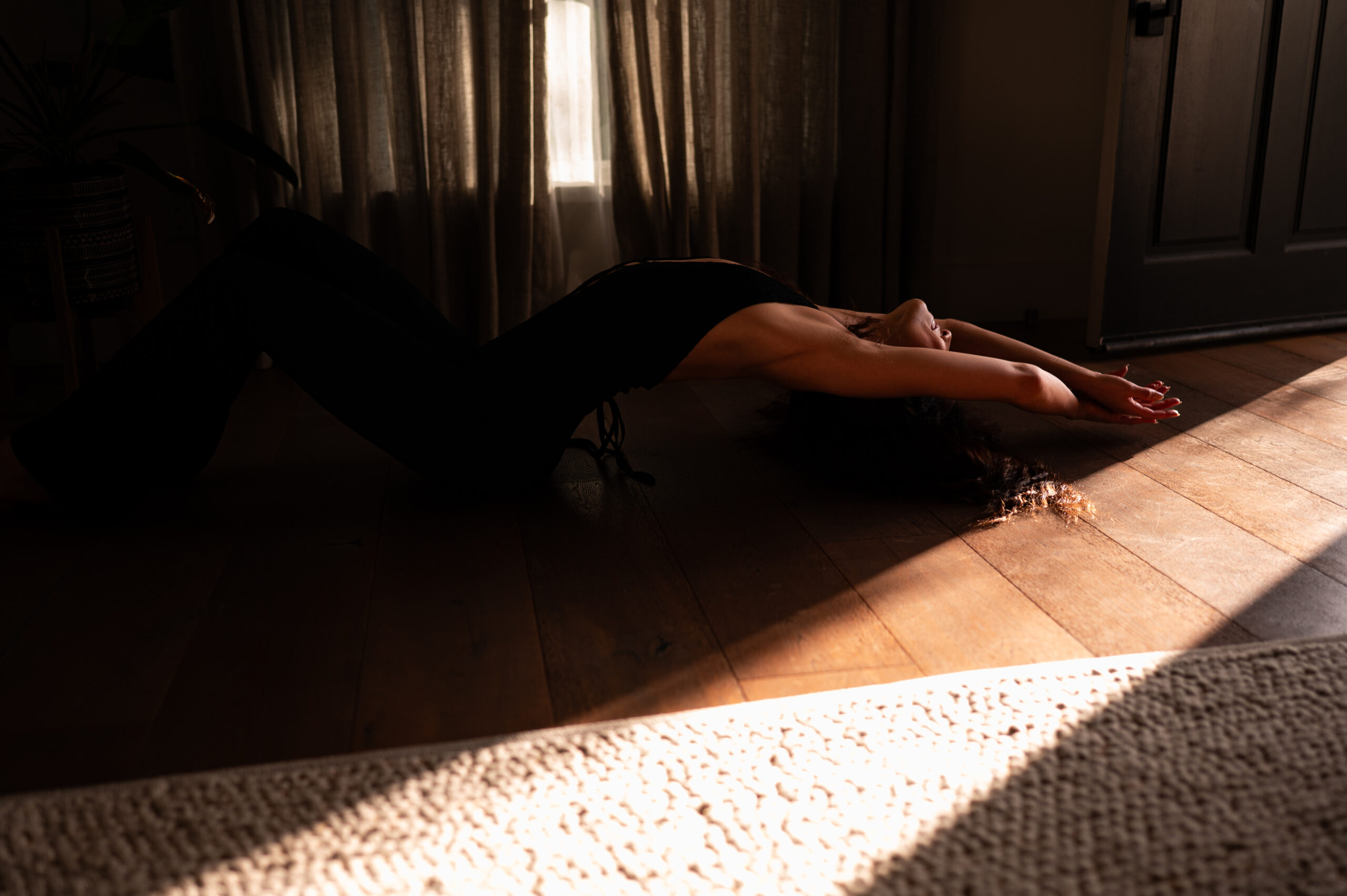
The first pose is a floor pose. You lie down and arch your back so that only your head and your butt are touching the ground, your arms extend overhead, and your feet are staggered.
I’ll be honest, this is one of the more uncomfortable poses in my rotation, but we never stay in it long. That brief moment of effort creates strong elongation and a gorgeous arch through the whole body.
It works for nearly every body type because it emphasizes shape and curvature rather than size or any one feature. It pulls attention away from the places people feel insecure about and puts it on lines and structure instead.
There’s a lot of room to adjust here. You can use your arms to cover any area you’re self-conscious about, like the midsection. Hand placement changes the whole mood too: hands in the hair, stretched overhead, or traced along the chest and thigh, whatever flatters you most.
Boudoir Photography Pose 2: The Chair Straddle
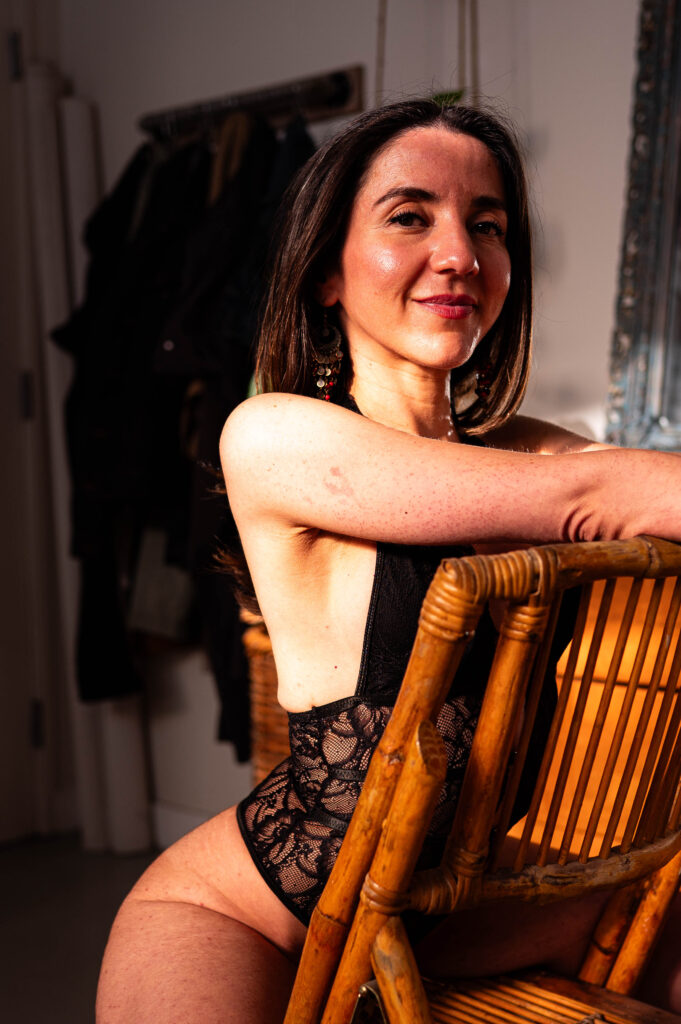
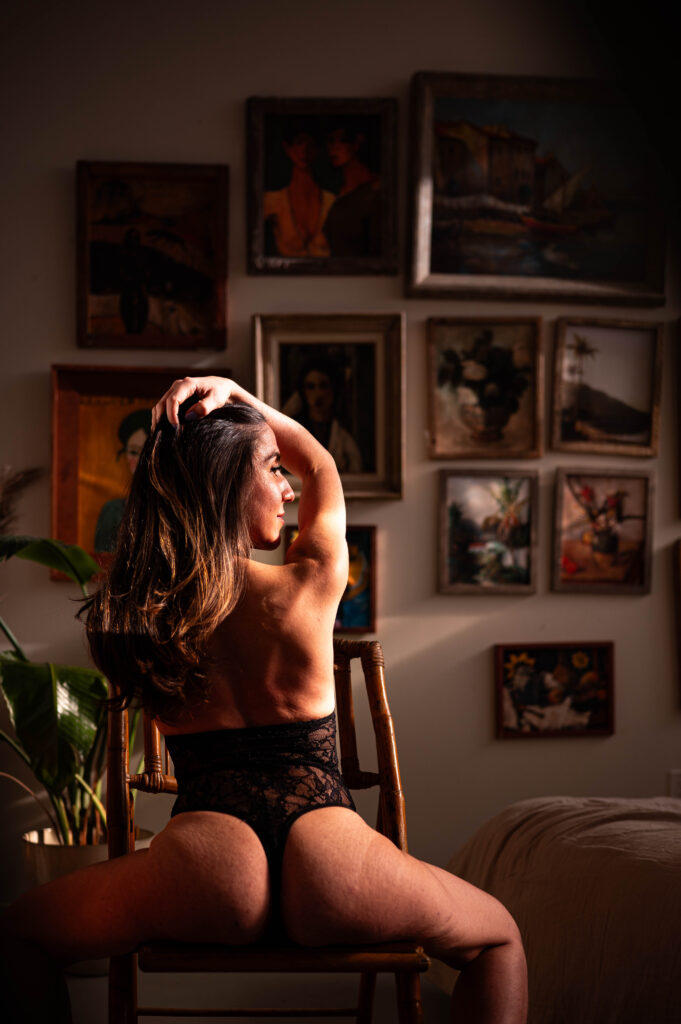
This one uses a chair. You straddle it facing the back, legs out to the sides, toes pointed, and arms extended over the back of the chair or resting on it.
What I love about the chair straddle is its versatility. I can shoot it from the front, the side, or the back, so a single setup gives us a whole range of images.
It flatters most body types because it conceals the midsection while emphasizing your curves, especially the hips and glutes. It’s also a fantastic pose for creating the look of a fuller, more dramatic silhouette.
The main adjustment here is height. Depending on your proportions, you might kneel instead of sit so the chair setup fits you properly. The goal is always to make sure the lean and the positioning feel natural and supported, never strained.
Boudoir Pose 3: The Couch and Coffee Table Extension
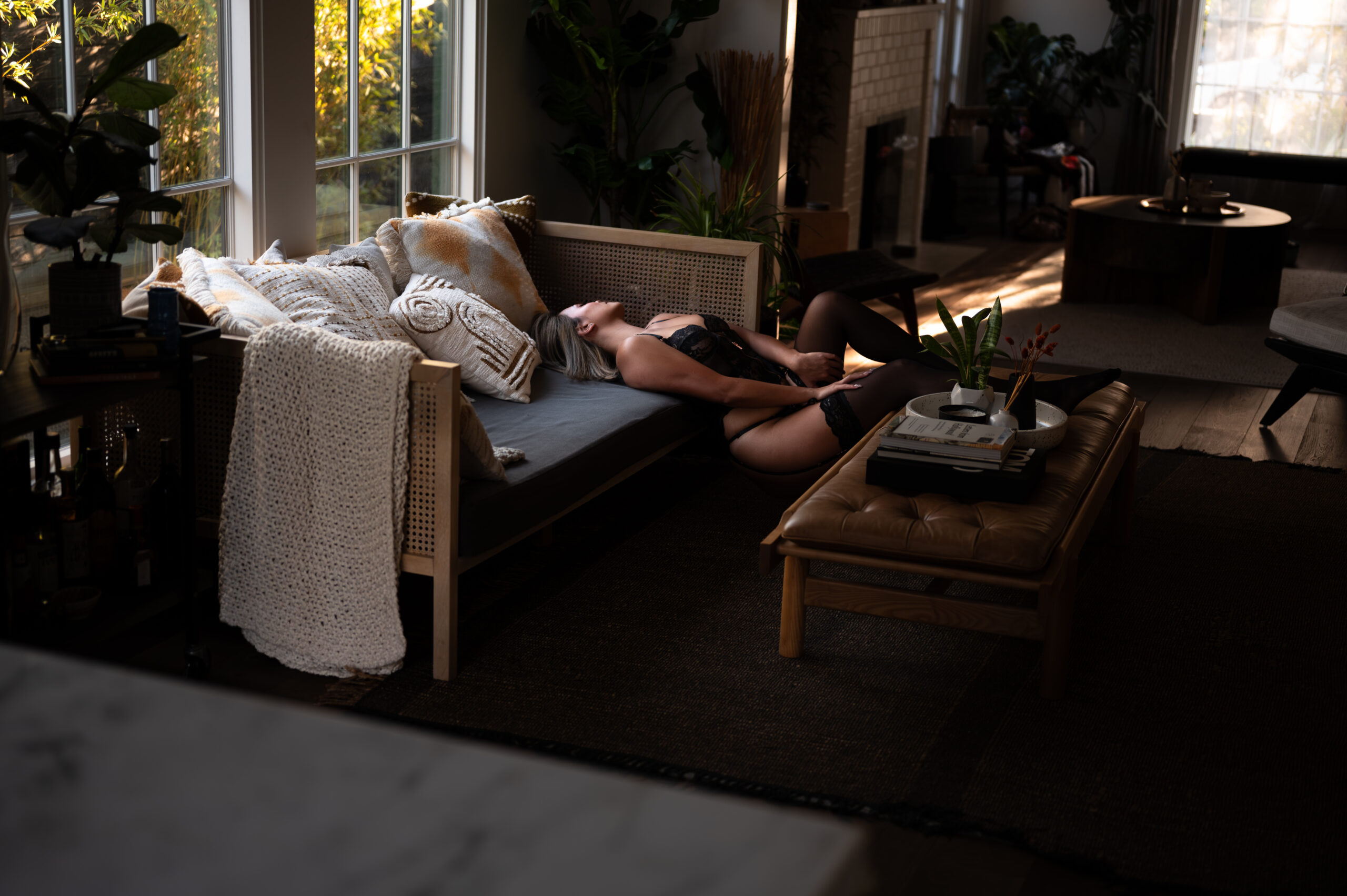
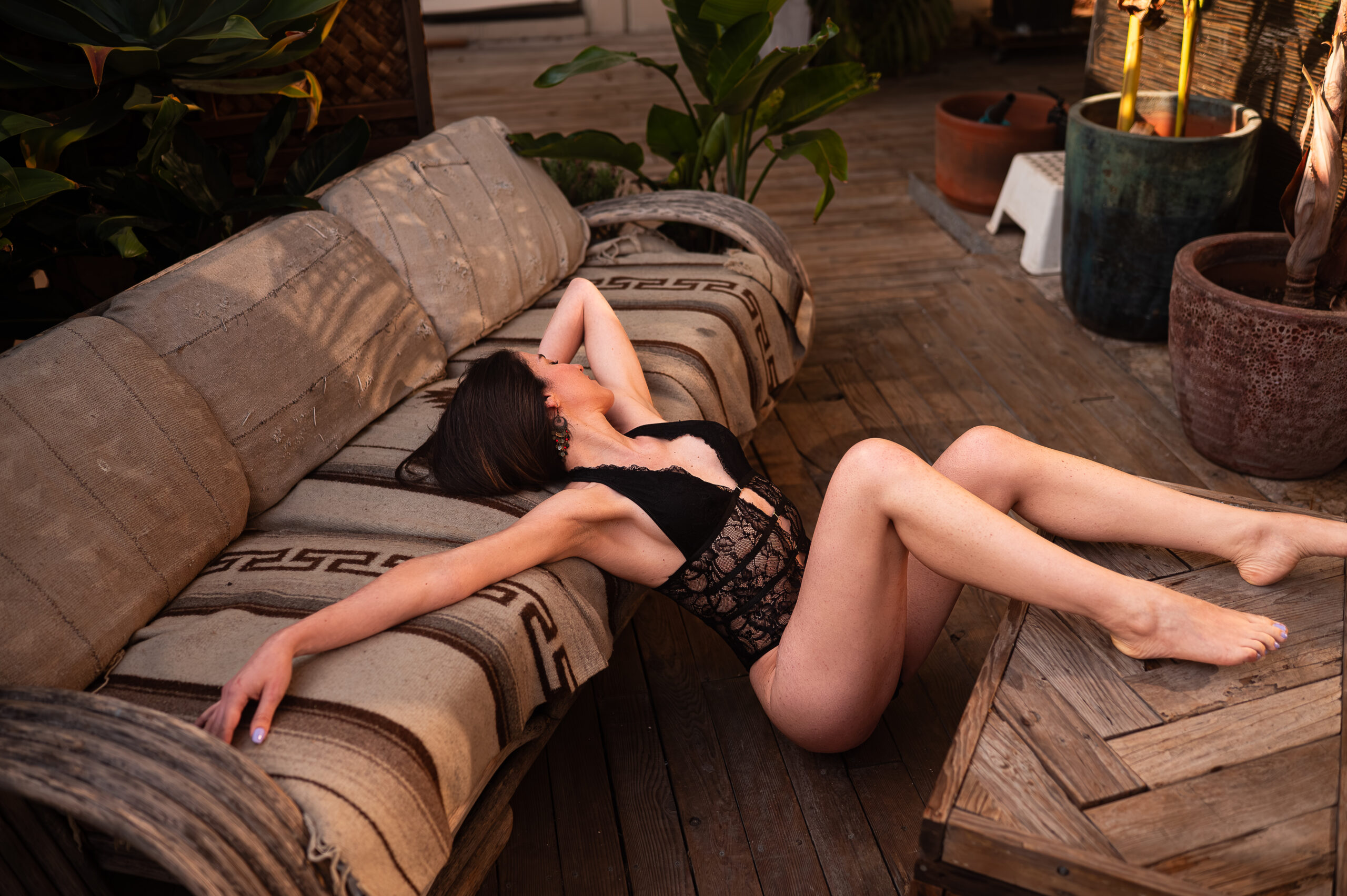
For this pose, you rest your shoulder blades on the edge of a couch with your butt hanging just off the edge and your feet planted on a coffee table. Your arms extend outward to create openness through the body.
This pose highlights curvature and creates a strong, sweeping arch, and it’s so consistently flattering that I include it in almost every session.
The main thing I’m watching for is the distance between the couch and the table, which I adjust based on your height. Sometimes the setup needs tweaking if the table is too tall or too far away. The most common mistake is sliding too far down the couch, which flattens the arch, but once we correct that, the shape becomes genuinely dramatic and elegant.
A lot of clients feel unsure about this one going in because it’s not a natural position to be in. Then they see the final image and they’re blown away. That reaction never gets old.
ELI Boudoir Pose 4: The Kneeling Mirror Pose
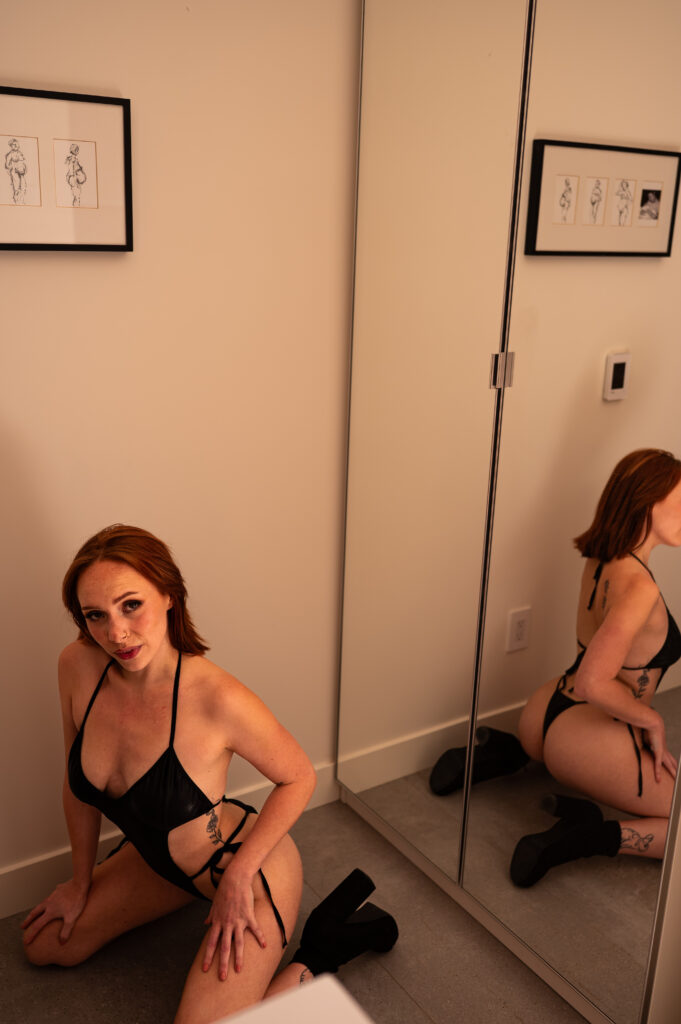
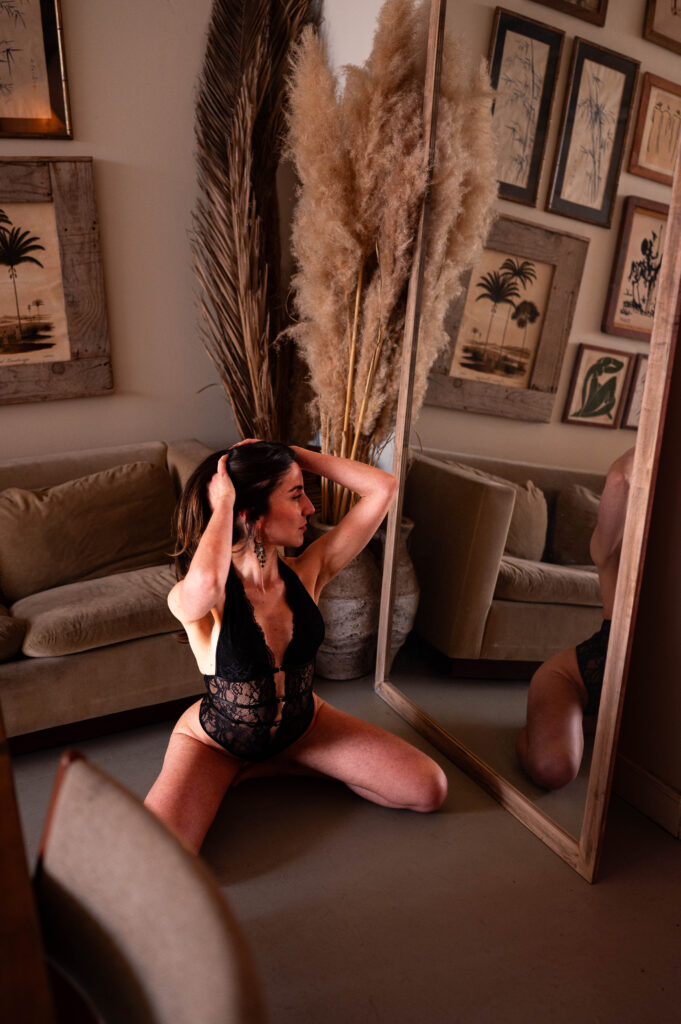
Here you kneel, forming a triangle shape with your knees and toes, and we usually set this one up in front of a mirror.
You’ll start facing the mirror, and I’ll encourage you to interact with your reflection. Hands begin in the hair and slowly trace down the body. It sounds simple, but this is where confidence and sensual awareness really start to build. From there, you rotate to face outward and we capture a few more variations.
This is one of my favorite go-to boudoir poses because of how flexible it is and how much emotional impact it carries. It highlights your curves while leaving plenty of room for expression and movement rather than rigid positioning. For a lot of clients, the mirror pose becomes the turning point in the whole session, the moment they actually start to feel comfortable being photographed.
Boudoir Pose 5: The Wall Lean
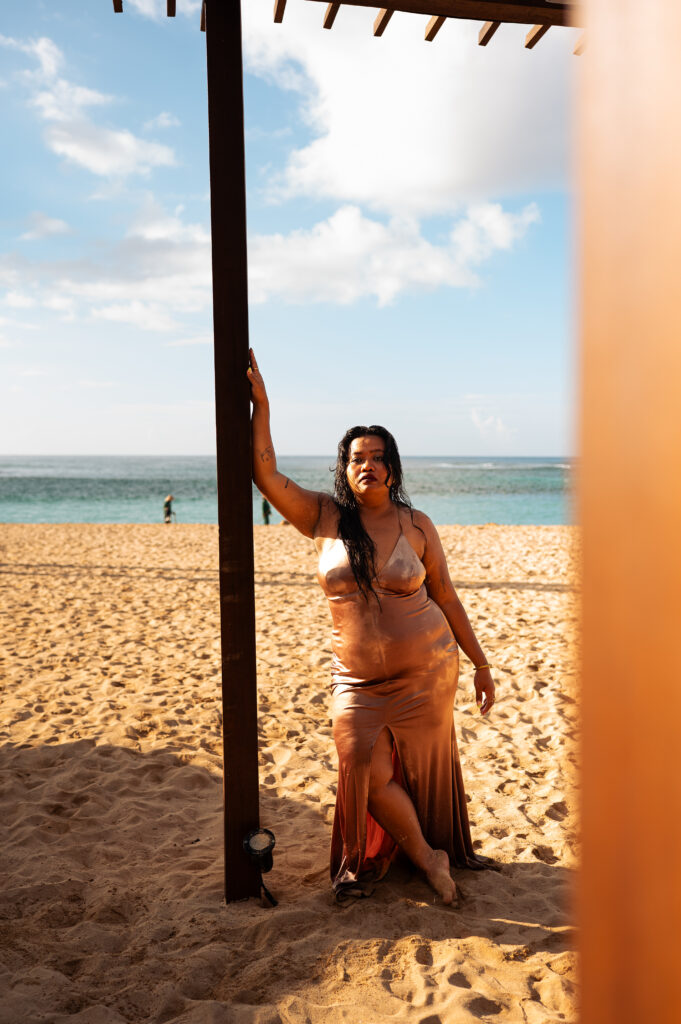
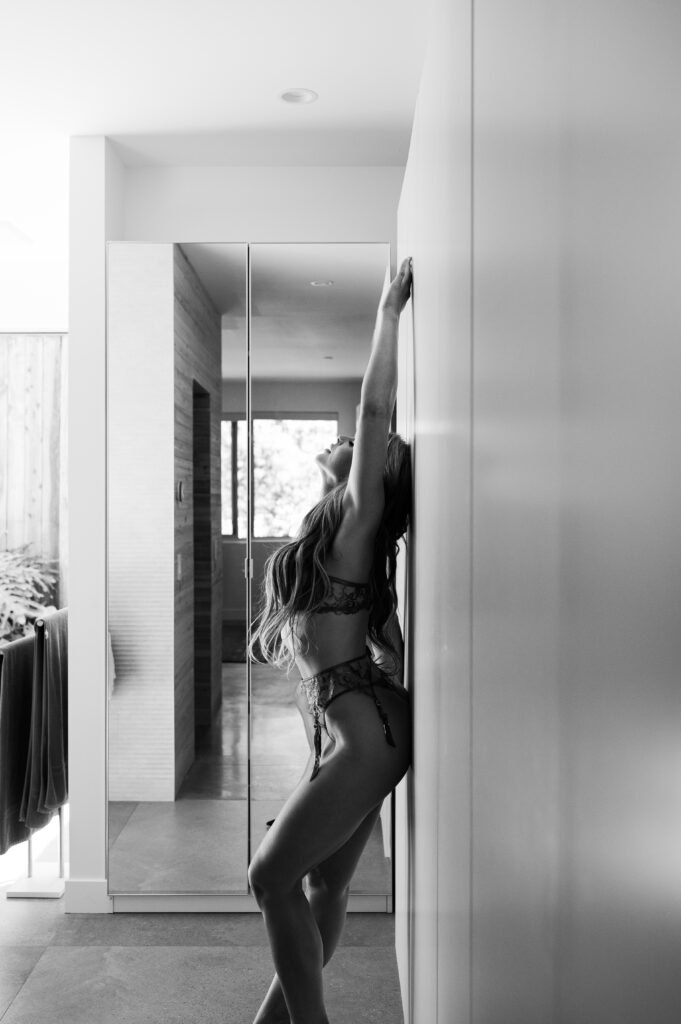
The last pose uses a wall. You stand about one to two feet away, lean an elbow or arm against the wall, and cross one foot over the other to engage the hip. Your opposite arm can rest on your hip, hang naturally, or extend overhead for variation.
The wall lean elongates the body while accentuating your curves through that crossed-leg position and the lean. It’s incredibly versatile and comfortable for most people.
This is my most beginner-friendly pose, and it’s the one I reach for with clients who have mobility concerns or who feel uneasy kneeling or lying down. The adjustments are small, usually just where the arm goes or whether you press into the wall with a palm instead of an elbow. If you want a grounded, standing option that feels safe and still looks stunning, this is it.
What Photographers Get Wrong About Posing for Different Body Types
The biggest divide in this industry is between photographers who try to hide a client’s insecurities and those who help them embrace them. I’m firmly in the second camp. My job isn’t to conceal your body, it’s to help you see it differently. When you over-conceal, you take away the whole opportunity for confidence-building and self-acceptance, which is the entire point.
There’s also far too much emphasis online on treating plus-size and straight-size bodies as if they require fundamentally different posing. I don’t believe that’s true. The same poses work for all bodies with small adjustments. What actually matters is communication and adaptability during the shoot.
And so much of the advice floating around out there quietly increases insecurity by making people feel like they should already know how to pose. You’re not supposed to know what you’re doing. That’s literally what you’re hiring me for.
A Transformation I See Again and Again
A pattern I see constantly: a plus-size client arrives nervous about her stomach or her overall size, often having been told her whole life that certain poses just won’t work for her body. Then, as the session goes on and she gets more comfortable, something shifts. By the time she sees her images, she’s no longer fixated on the insecurities. She’s looking at how beautiful and empowered she looks. Many tell me the photos feel like a direct challenge to all the negativity they’ve absorbed over the years.
I see it the other way too, with clients who feel like they lack something, maybe curves or a defined shape. Through the right posing and angles, they end up seeing features they never noticed or appreciated about themselves before. That moment of recognition is the best part of my job.
Universal Boudoir Posing Principles
No matter your body type or the pose, a few core principles carry through almost everything I shoot:
- Arch your back as much as you can, even when it feels uncomfortable.
- Always point your toes to create elongation.
- Keep your hands moving and engaged, but never rushed.
- Embrace the discomfort. What feels awkward often photographs far better than what feels natural.
- Communicate throughout the shoot so we can adjust for comfort and safety as we go.
These few rules create consistent structure and flow across every pose and every body.
The Real Takeaway about the Best Boudoir Photography Poses for ALL Body Types
If you remember one thing, let it be this: boudoir poses are for everyone. Boudoir isn’t about hiding your insecurities, it’s about learning to embrace them and see them in a new light. And when I say everyone, I mean it — you can absolutely have boudoir photos taken at any age, and these same five poses adapt beautifully across the board.
And the experience matters just as much as the final images. The photographer plays an enormous role in how you feel during the shoot, and that feeling shows up directly in how you see yourself in the photos. This is exactly why it’s worth taking the time to choose the right boudoir photographer rather than simply the closest or cheapest one. Boudoir is inclusive by nature. It’s meant to build confidence, not restrict it. Every body is worthy of being photographed, and the right photographer will help you see exactly that. If a photographer ever makes you feel anything less than empowered, they are simply not the right fit for you.
If you’re ready to experience this for yourself, you can explore what a session looks like and what’s included on my investment page. Every body is worthy of being in front of the camera, and I’d love to help you see yours the way I do.