
August 11, 2026
August 11, 2026
Can Boudoir Help you Connect with your Body after Pregnancy?
Can boudoir help you connect with your body after pregnancy? Pregnancy changes so much more than your stomach or the number on the scale. In the months after having a baby, you might notice your skin feels different, your hair is shedding or growing in a new texture, your breasts have changed shape, your hips sit differently, or there are scars or stretch marks that weren’t there before. Your energy is different. The way your body feels when you move through an ordinary day is different. Some of these changes fade, some lighten, and some remain.
But when I talk with new mothers, the deepest struggle is almost never about one specific physical change. It’s something harder to name. Over and over, women tell me the variations of the same sentiment: “I just don’t feel like myself anymore.”
I understand why. Motherhood has a way of making your body feel like it belongs to everyone else. It belongs to your baby, to your recovery, to feeding schedules and medical appointments, to the person who needs to be held, soothed, and fed at 3 a.m. Your body becomes something that performs, provides, and shows up for other people all day long. At some point, the relationship you used to have with your own body can slip away.
Here is the heart of what I want you to know, and the reason I do this work: a postpartum boudoir session is not about returning you to your pre-pregnancy body. It isn’t a “before and after.” It’s a way to reconnect with the woman who still exists inside your changed body. She didn’t disappear. You just haven’t had a quiet, unhurried moment to look at her in a long time.
There’s research showing that early motherhood can affect body image, self-esteem, identity, and the way women feel about themselves overall. If you’ve felt some of this, you’re not imagining it and you’re not alone. I also want to be clear and honest with you: boudoir is not medical care and it is not mental-health treatment. It’s a personal, creative experience. What it can offer is self-recognition, celebration, and a real, lasting shift in confidence. If you’re carrying something heavier than that, please lean on the appropriate professional support too. Boudoir can sit alongside that beautifully, but it doesn’t replace it.
Table of Contents
Why You May Feel Disconnected From Your Body After Pregnancy
Pregnancy can make a familiar body feel completely new
The list of changes women experience and carry with them into my studio is extensive. Women feel like these are flaws, but I truly do not perceive it that way. To name a few:
- Weight changes
- Loose or changed skin
- Stretch marks
- C-section scars
- Breast changes from pregnancy and feeding
- Hair loss or a new texture
- Different proportions than before
- Changes in strength, mobility, or flexibility
Here’s the part people don’t warn you about. Even the changes you fully expected can feel unfamiliar the moment you see them on your own body. You can know intellectually that your stomach will look different and still feel a jolt the first time you notice it. That is normal.
And feeling that way does not make you ungrateful. You can be in awe of what your body did, growing and birthing an entire person, and still have complicated, tender feelings about how it has changed. Both things live in the same body at the same time. Feeling disconnected from your body after pregnancy isn’t a form of failure. It’s a very human response to a monumental change.
Motherhood can change the way you see yourself
When you become a mother, your identity can quietly reorganize itself around being needed. You know where everything is, anticipate every need, and hold it all together. That is beautiful in its own way, but it can also crowd out the other parts of your identity.
Loving motherhood and missing pieces of yourself do not have to coexist. You can adore your child with your whole being and still miss the version of you who felt sensual, desirable, independent, playful, or bold. Those parts of you didn’t leave. They just haven’t been given room to breathe recently.
I want to gently deconstruct two things people tend to intertwine. Losing touch with your sexuality after having a baby doesn’t necessarily mean losing interest in your partner. Much more often, it means losing your personal relationship with your own body, the sense of it being yours to enjoy. And there are so many ordinary reasons this happens: exhaustion, almost no time to yourself, physical recovery, fluctuating hormones, feeding schedules, and being touched all day long. When your body is “on” for someone else every waking hour, it makes sense that your own relationship waivers.
Postpartum beauty standards make the adjustment harder
Then, on top of all of that, comes the pressure. “Bounce back.” “Lose the baby weight.” Hide the stretch marks. Get back to your old self as quickly as possible, as if the goal is to erase all evidence other than your baby.
I think “getting your body back” is the wrong goal, and I’ll tell you why: your body never went anywhere. It’s been right with you the entire time. The idea that your postpartum body is some unfinished, temporary draft that has to be fixed before it is appreciated or photographed is one I take issue with.
So let me state where ELI Boudoir stands, clearly: you do not need to be smaller, smoother, fitter, or more confident before you are worthy of being seen. You are worthy of loving yourself, exactly as you are today.
What Reconnecting With Your Postpartum Body Actually Means
Reconnecting does not mean pretending you love every change
I want to remove the pressure, because I think a lot of body-positivity messaging accidentally adds pressure instead of removing it. Reconnecting with your body does not require you to instantly, unconditionally love every part of it. That is nearly impossible for anyone, let alone after experiencing tons of physical changes.You don’t need that threshold in order to walk through my door.
Connecting with yourself can start much smaller. Start with neutrality or noticing small details. Maybe it is appreciating your eyes or your love handles. Start with allowing yourself to be present in your body for an hour without a running inner critic. If it sounds impossible, try it.
You are allowed to appreciate everything your body has done and still have mixed feelings about how it looks and feels now. You do not have to arrive at your session in a state of perfect self-love. To be fully transparent, nobody does.
Reconnecting means truly seeing yourself again
When I say “reconnecting with your body,” what I really mean is truly seeing yourself again.
Think about how most of us actually look at our bodies. It’s fragmented. We look only at our stomach in the mirror. We check how a pair of jeans fits. We examine our stretch marks up close, in bad lighting. We hold a current photo next to an old one and pick ourselves apart. We almost never look at our whole selves. We zoom in on the one part we’ve decided is the problem.
Boudoir is an opportunity to do the opposite. It creates a chance to see yourself in totality, rather than fixating on one small area. And when you see yourself as a whole, everything changes, because posing, movement, expression, light, emotion, and your own personality completely change how you experience a photograph of yourself. You’re not the sum of your most-criticized parts. You never have been. A stunning photograph lets you finally see that.
You are still a woman outside of what your body does for others
There’s a difference between your functional body and your personal body. After pregnancy, your body can feel unnaturally functional. So much of your time is consumed with recovering, feeding, soothing, and caring. All necessary but immensely fatiguing.
Boudoir makes space for another aspect of yourself. The version that gets to be expressive, sensual, creative, strong, soft, or playful for no reason other than that it’s yours. And I want to underline this: your sensuality belongs to you. It is not something that exists only for a spouse or a partner. It’s yours, first and foremost, whether or not you ever share a single image with anyone.
How Postpartum Boudoir Photography Can Help You See Yourself Differently
Boudoir lets you see yourself from someone else’s perspective
Insecurities narrow your attention. A client often walks into my studio hyperfixating on one thing: her stomach, her stretch marks, or her figure. Her whole focus is on the part she’s decided is wrong.
I’m looking at focusing on something different. Her essence:
- Her expression
- The way she carries herself
- Her curves
- Her movement
- Her softness
- Her strength
- The emotion in the photograph
A photograph can interrupt the distorted, overly critical picture you’ve built up from studying yourself too closely for too long. When you’ve only ever seen a body part in isolation, in a mirror, at your most self-critical, of course it looks wrong to you. Boudoir lets you see how beautiful your body actually is the moment you stop fixating on the smallest parts of it.
The session gives you time that is centered entirely on you
New mothers almost never get an experience where they are the sole focus. Think about it. When was the last time an entire block of three or four hours dedicated to yourself?
During a postpartum boudoir session, you don’t have to care for anyone else. You don’t have any household tasks waiting for you. You are not managing another person’s comfort. For a few hours, the focus is on you, and you alone. Professional makeup, help planning your wardrobe, easy going conversation, music, posing guidance, and steady encouragement. All things a lot of mothers haven’t felt in a long time: the feeling of being cared for instead of being the carer.
I think of it less as a photoshoot and more as intentional personal time to reconnect with yourself that happens to produce beautiful images. And here in Los Angeles especially, mothers are balancing demanding careers, real commutes, relationships, extended family, and childcare all at once. Dedicated, protected time for yourself is a necessity. It is hard to come by, meaningful and essential.
Guided posing can help replace self-consciousness with presence
Let me put one fear to rest immediately: you are not expected to know how to pose. That’s my job, not yours.
Here’s how I work:
- We start with simpler, less intimidating poses
- I demonstrate each movement myself so you can see it
- I give clear, specific instructions
- We move gradually through standing, sitting, and lying-down poses
- I check in with you regularly
- We adjust anything that doesn’t feel good
When you’re concentrating on your breathing, a small movement, where your hand goes, the look on your face, your mind simply has less room to spiral about perceived flaws. Focus helps drown out the internal criticism. That and I will periodically show you how beautiful you look.
And I want you to know something about how a pose feels versus how it looks. A pose can feel completely unfamiliar and awkward and still look breathtaking. This is just the reality. You are not used to contorting your body in these ways. I will never tell you that you look awkward or bad, because that’s not true and it’s not helpful. If something isn’t working, I just make a small adjustment or move us into a pose that feels more natural.
Encouragement can change the emotional tone of the experience
Postpartum clients often need more reassurance. I am happy to be your personal hype woman. If you need more communication, more reassurance, more patience, just speak up.
My approach is simple. I become your number one cheerleader for the whole session. That steady stream of encouragement is what helps you move, over the course of an hour or two, from:
- Nervous to exhilirated
- Guarded to relaxed
- Self-conscious to present
- Doubtful to proud of your bravery
I won’t pretend a single photoshoot permanently cures every body-image struggle, because that is simply false and I will never lie to you. What I will say is that it can be a genuinely meaningful moment, one that challenges the beliefs you currently hold about your body and gives you real evidence to the contrary.
What Postpartum Clients Commonly Worry About Before Their Boudoir Session
“I do not like my stomach anymore”
The stomach is, by far, the concern I hear most from postpartum clients. So let’s talk about it directly.
A good boudoir photographer should never treat your stomach as something shameful. If they do, they are the problem, not you. There’s a real difference between flattering posing and trying to make your body look smaller than it is.
My philosophy is that posing should celebrate your body, not minimize it. Of course everything from angles, poses, and wardrobes can be adjusted depending on your comfort. But I will never treat your body, and especially your stomach as a problem.
“What about my stretch marks or C-section scar?”
Stretch marks and scars are common, especially with a postpartum boudoir photoshoot. They are not blemishes to be ashamed of. They are normal and tell your story.
You can emphasize or minimize them with different outfit choices. I would recommend both if you are unsure. They deserve to be seen, but I want to make sure you leave your photoshoot with artwork that makes you feel beautiful and powerful.
This is also exactly why you should ask any photographer about their retouching before you book. At ELI Boudoir, I don’t slim or reshape my clients’ bodies. Natural retouching, to me, does not include removing parts of you that tell your story.
“I no longer feel sexy after having a baby”
First, that feeling is completely normal, and I hear it frequently. Stop treating it as a personal failure.
Here is my favorite way to think about it. Sexuality and sensuality do not have to begin with a partner. They are internal. A boudoir session is a low-pressure space to explore your expression, confidence, movement, and your own personal style, on your own terms, solely for yourself.
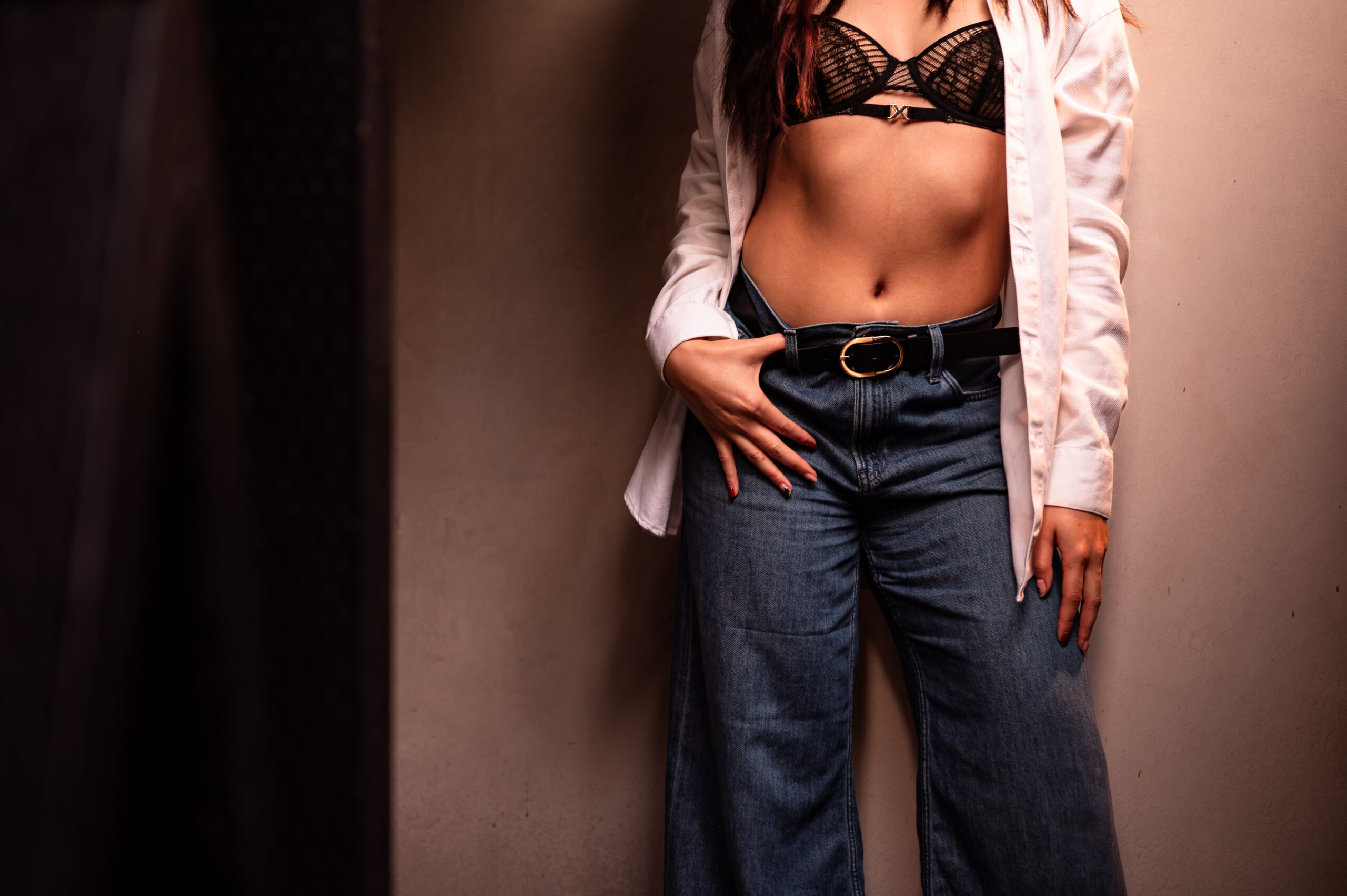
And you’re always in control of how revealing or how conservative the session is. The primary goal of your boudoir photoshoot is to feel confident and beautiful. That does not have to involve any nudity or revealing lingerie. Here are a few of my favorite ideas:
- Bodysuits
- Blazers with bra and panty sets
- Button-down shirts with bra and panty sets
- Dresses
- Sheets
- Sweaters/Oversized Clothing
- Lingerie
You get to define your boudoir shoot for yourself. It is an experience that you get to design.
“I have never posed and I am going to look awkward”
Almost none of my clients have ever professionally posed before. That is totally normal, and so is being nervous about it.
Being photographed is a skill. It is not a prerequisite to investing in a boudoir shoot. Your photographer’s communication, posing style, and ability to build trust with you are what create the stunning result.
What I see happen routinely is that the nervousness fades pretty quickly once you realize you’re going to be guided through every single step. You’re never left standing there wondering what to do with your hands. I’ve got you covered.
“I need to lose the pregnancy weight first”
Let me answer this one as directly as I can: no, you do not need to lose weight before a postpartum boudoir shoot.
Waiting for a future, thinner body reinforces the very belief we’re trying to leave in the dust…That your current body doesn’t deserve to be celebrated. Every time you postpone until you hit an arbitrary goalpost, you are reinforcing that idea.
And here’s something I’ve watched happen multiple times: weight loss doesn’t automatically hand you confidence or self-love. Plenty of women reach their ideal weight and still don’t feel at home in their skin, because that was never really the issue.
So can boudoir help you connect with your body after pregnancy? The short answer is yes. I’ll leave you with the message I most want my future postpartum clients to hear: boudoir is not the reward you get after you’ve become confident. It can be part of how you begin building that confidence in the first place.