July 19, 2024
July 19, 2024
Can Boudoir Photography Change How You See Yourself? My Story
I don’t believe boudoir photography magically fixes body image. I do believe it can give you a different way to see yourself, and I know that because it changed something in me long before I became a boudoir photographer.
This is my story — how I got here, and why I do this work.
Table of Contents
I Didn’t Always Feel Comfortable in My Body
I was born in England and moved to Boulder, Colorado when I was almost ten. If you’ve ever been to Boulder, you know how little diversity there is. Where I came from was mixed — lots of different people, different faces. Colorado was a culture shock, to say the least.
When I started middle school, I was the only brown kid, and none of my peers would talk to me. At the time I didn’t have a word for what was happening — I didn’t understand it as racism. So I did what a lot of kids do when something feels wrong and no one explains it: I decided the problem was me. Specifically, I decided the problem was my body.
There was no one around who looked like me, and every image of “beautiful” I absorbed looked the same — and it wasn’t me. When I rarely saw people who looked like me reflected back as beautiful, I slowly started to believe I wasn’t. That belief settled in early, and it stuck.
How Those Experiences Changed the Way I Saw My Body
By high school, that relationship with my body had only gotten worse. Somewhere along the way I picked up the idea that my worth and my beauty came from my body rather than from who I was.
I’ll be honest about a hard part of this, because I think it matters. As a young teenager I sent boys “nudes” — I was never fully naked, but I was far too young to be doing it at all. One of those times, the boy showed his friends, and the photos got passed around. Looking back now, I’m astounded he had the audacity. At the time, all I felt was shame.
I also went through a number of experiences of assault that ranged in severity. I’m not going to detail them here, and I don’t want to turn them into a headline. But I do want to name plainly what they did: they left me feeling unsafe in my own skin, and taught me — wrongly — that men were entitled to my body.
What I want to focus on is what happened to my relationship with my body afterward. It didn’t just stay bad; it became something I actively fought with. My body started to feel like the source of everything that had gone wrong, instead of the thing that had carried me through all of it.
In college, I did real work on this — shoutout to my therapist, Lori, who is amazing. Unlearning all of it took time, and if I’m honest, I’m still doing the work. But this is where my story starts to turn.
If you have been assaulted and need support, please reach out to RAINN.
Then I Discovered Boudoir Photography
Somewhere in the middle of college, a couple of my best friends and I decided to do each other’s boudoir photos.
I want to be clear about where my head was going into it: I was not confident. I wasn’t doing this from a place of “I love my body, let’s celebrate it.” I was nervous. Part of me expected to look at the images and see exactly what I’d been trained to see — every flaw, every part I’d learned to hide, proof of everything I already believed about myself.
We did them in our underwear, just us, no audience and no pressure. Honestly, I figured the best case was that a few pictures would come out “okay” and I’d quietly delete the rest.
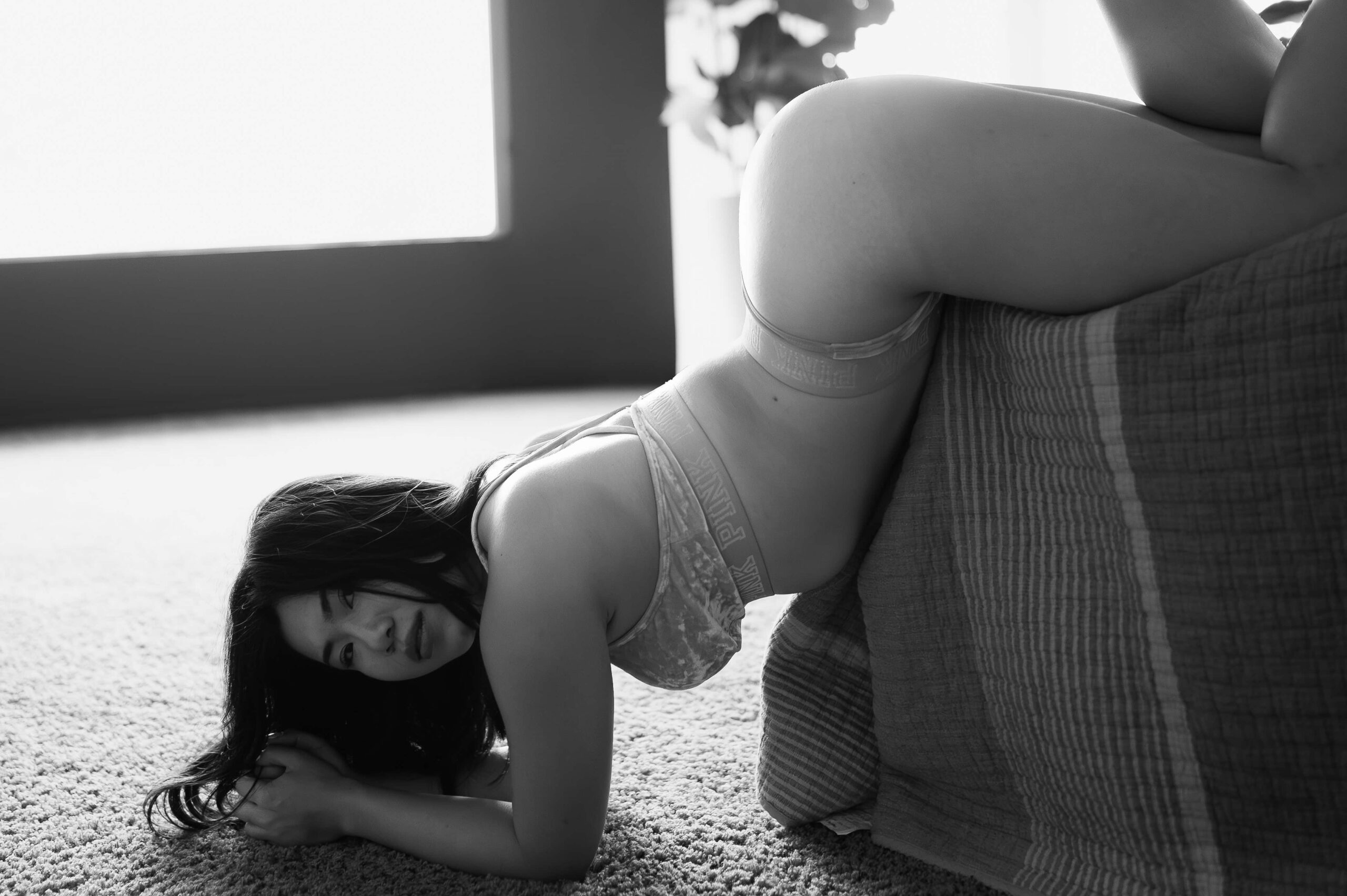
That’s not what happened. What surprised me first was how it felt to be in front of the camera on purpose — not hiding, not sucking in, not angling myself away. For once I wasn’t managing how my body looked for someone else’s benefit. I was just in it. And when I finally saw the images, my first reaction wasn’t the flood of criticism I’d braced for. It was closer to recognition. Huh. That’s me. And she looks good.
Seeing My Body Through a Different Lens
Here’s the thing that actually changed me.
In those photos I could see everything I’d spent years hating. My stretch marks. My rolls. A few pimples. My actual body — not a posed, sucked-in, filtered version of it, but the real one, with every part I’d been taught to dislike right there in the frame.
And I still felt beautiful.
That’s the whole realization, and I want to be precise about it, because it’s easy to get wrong. It wasn’t “boudoir fixed me.” It wasn’t that the photos hid my flaws, or that I’d finally started to look like the images I grew up comparing myself to. It was this: I realized I didn’t have to fix my body before I could see it as beautiful. The stretch marks and the rolls and all the rest were still there — and beautiful was still true at the same time. Those two things were allowed to coexist. No one had ever told me that.
Why I Still Look at Those Photographs Years Later
Those photos were taken years ago now. I still look at them.
This is the part most boudoir photographers can’t tell you, because they haven’t lived it: I have my own photographs, and they’ve become an ongoing reminder of who I am.
When I’m having an insecure day — and I still have them — I pull them up. And they tell me something my insecurity can’t argue with. This is me. This body existed before today’s bad feeling. This body was beautiful then, in a photo, with all the same “flaws” I’m fixating on right now. It doesn’t suddenly become less beautiful because I woke up not liking it. The photos are evidence, and evidence is hard to argue with. Even years later, they can pull me out of a bad body-image day in a way very little else can.
Can Boudoir Photography Actually Change How You See Your Body?
Let me step out of my own story for a second and answer the bigger question honestly — because you deserve honesty, not a sales pitch.
I don’t think boudoir is therapy. I don’t think one photoshoot resolves trauma or undoes years of body image struggle. Anyone who promises that is selling you something. My confidence came from a lot of things — time, real work, Lori — and boudoir was one piece of it, not a magic fix.
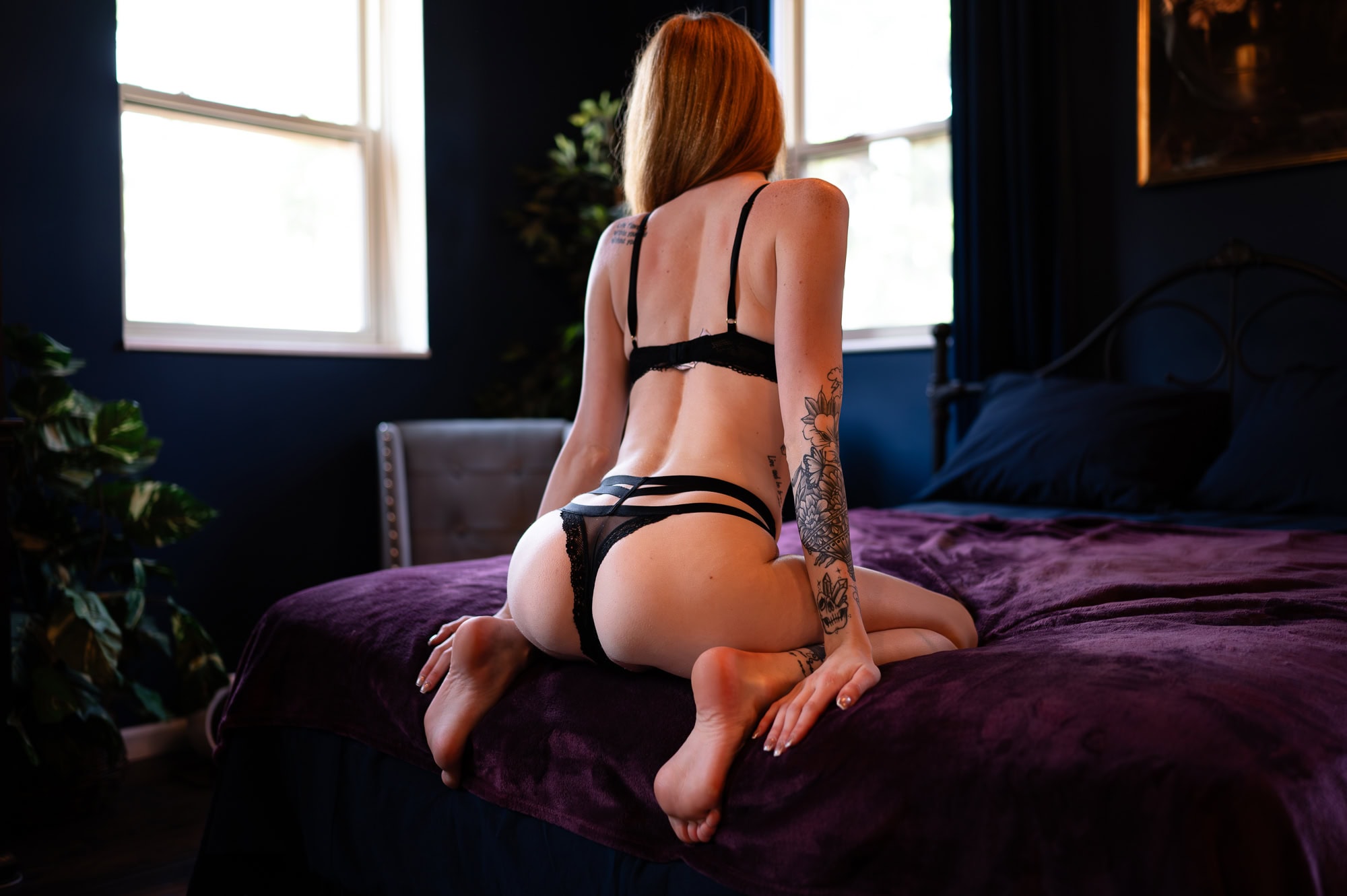
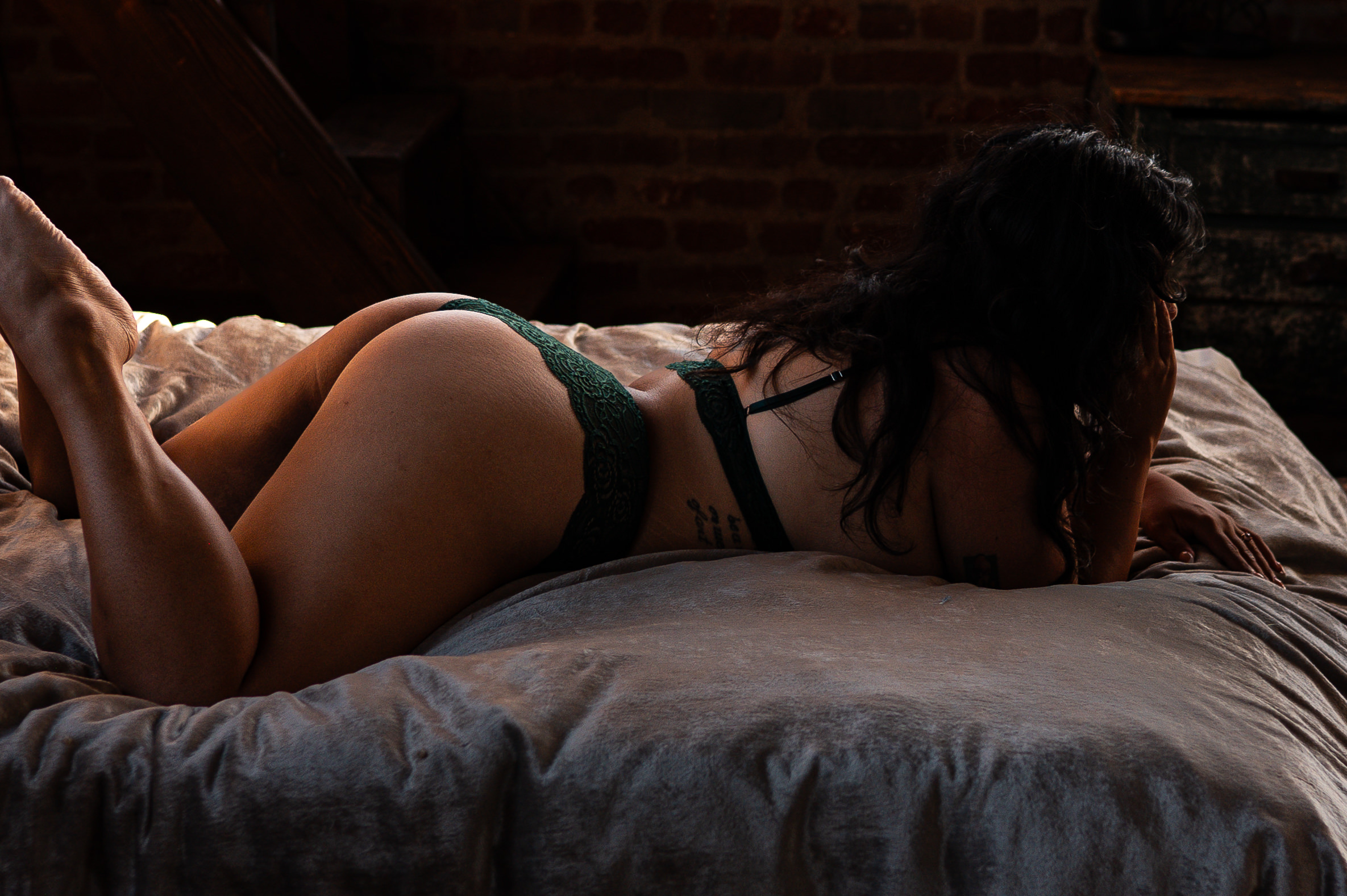
So here’s what I do believe a session can give you. A different visual perspective on yourself, from the outside, instead of the mirror. Evidence that you can feel beautiful now — not after some future change, but now. The experience of being photographed without hiding, which is its own quietly radical thing. A chance to inhabit your body for an afternoon instead of criticizing it. And photographs you can come back to later, on the days you need them.
That’s real, and it’s worth something. It just isn’t magic, and I’d rather tell you the true version.
You Don’t Have to Love Your Body Before Your Boudoir Session
The thing I hear most often is some version of: “I’ll do it once I lose some weight,” or “once I feel more confident.”
I understand it, and I want to gently push back on it. You don’t have to arrive at the finish line before you’re allowed to document yourself. You might feel more confident later — great, do another session then. But a huge part of the experience is learning to be with your body where it is right now, not the hypothetical future version of it.
If you want to sit with this idea more, I wrote a whole post about why you shouldn’t wait for your body to change before you let yourself feel beautiful — and another with a step-by-step process if you’d rather work on self-love first.
What I Want Women to Know Before They Book a Boudoir Session
If you take nothing else from my story, take these:
- You don’t need to feel confident first.
- You don’t need a milestone or a reason.
- You don’t need to look like a model.
- You don’t have to give the photographs to anyone — they can be just for you. Mine were.
- You don’t have to love every part of your body every single day. You just have to be willing to see it.
Why This Became the Foundation of ELI Boudoir
This is why ELI Boudoir exists.
Not because Los Angeles needs another boudoir photographer, and not because I have a tidy list of reasons you should book. Because a set of photographs, taken by my friends in college, changed how I saw myself — and kept changing it, years later, on my hardest days. I know what that’s worth, because I’ve lived off it.
So I built the kind of experience I needed back then: a photographer who holds your hand through the whole thing and acts as your personal hype woman, who cares about your comfort more than the shot, and who understands that seeing yourself through the lens is a completely different thing than seeing yourself in the mirror. My whole goal is to help other women feel that — the internal kind of confidence that stays with you long after the session is over.
What I Wish I Had Known Before My First Boudoir Session
If you’ve been thinking about a boudoir session but keep telling yourself you’ll do it when you feel more confident, when you’ve lost the weight, when you finally love your body — maybe you don’t have to wait.
Maybe the session is part of how you get there.
If you’re ready, here’s what a shoot with me actually looks like: The ELI Boudoir Experience. And if you’re still wondering whether this is for you, read Who Is Boudoir For?
More on boudoir
A few resources if you want to keep reading — including my Los Angeles boudoir blog, where you’ll find deeper insights, real client experiences, and guides to the full boudoir experience:
- The most important questions to ask a boudoir photographer before you book
- How much does a boudoir photoshoot cost in Los Angeles?